Authority
The principal sets direction and bounds. Managers coordinate, operators perform sanctioned mutations, and workers execute only within delegated scope.
Early development · public engineering brief
AI Workflow Manager
Bounded, staged software work with explicit authority and independent proof.
The operating loop
Mission
AI agents produce useful work, but their own reports do not establish correctness or completion. WorkMan keeps a human principal in control while bounded workbenches separate coordination, execution, and independent proof — even when sessions or tools fail.
Implemented foundation
WorkMan separates authority, planning, execution, proof, and projection so no display or running agent can substitute for the system of record. These layers are in active use; finality and recovery transaction boundaries are still being hardened.
The principal sets direction and bounds. Managers coordinate, operators perform sanctioned mutations, and workers execute only within delegated scope.
The trunk is durable planning truth — benches, tracks, records, dependencies. The queue is the candidate lifecycle: recorded, reviewed, approved, packaged, activated into a live bench.
A local-first workbench binds a Git branch, worktree, staged brief, tmux runtime, and adapter-backed agent seats.
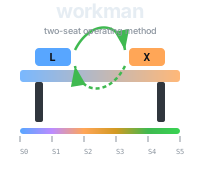
Gates, receipts, two-seat review, ref finality, cleanup, and rest establish what actually completed.
CLI, console, generated documents, and this static site expose selected read-only views.
Development trunk
Current work hardens the four failure modes below before ordinary unattended cycling begins. The runtime stays supervised until the full proof sequence holds.
Admission, materialization, runtime start, and physical-running truth must succeed or recover as one operation.
Every external effect needs an attempt record, exact result, read-back, and resumable unresolved state.
Todo and event state must use explicit roots, fail-closed locks, resolvable owners, and matching provenance.
Status and readiness checks must not modify state, and shutdown must leave a verified, fully cleaned baseline.
Preserve current evidence, correct the owner graph, and keep capacity at zero.
Repair activation, action evidence, ledgers, gates, finality, cleanup, and rest.
A negative path must refuse without mutation; a legal path must return to rest.
Routine capacity increases only after a supervised cycle completes cleanly.
Repository projection
Static public exports, not live runtime telemetry.
A curated selection of completed work, not an exhaustive record.
Snapshot timestamp pending.
Planning footprint
Aggregate counts only. Individual candidate details are never published.
Queue snapshot pending.
Snapshot timestamp pending.
Longer direction
After a supervised cycle runs clean, planned research will test order-of-magnitude reductions in context, mutation surface, and repeated guidance across language-neutral implementations while preserving critical interfaces and one source of truth. It is not active development.
Access
WorkMan is in private early development: there is no public download, sign-up, issue tracker, or repository access. The protected console admits only recognized accounts through its identity gate.